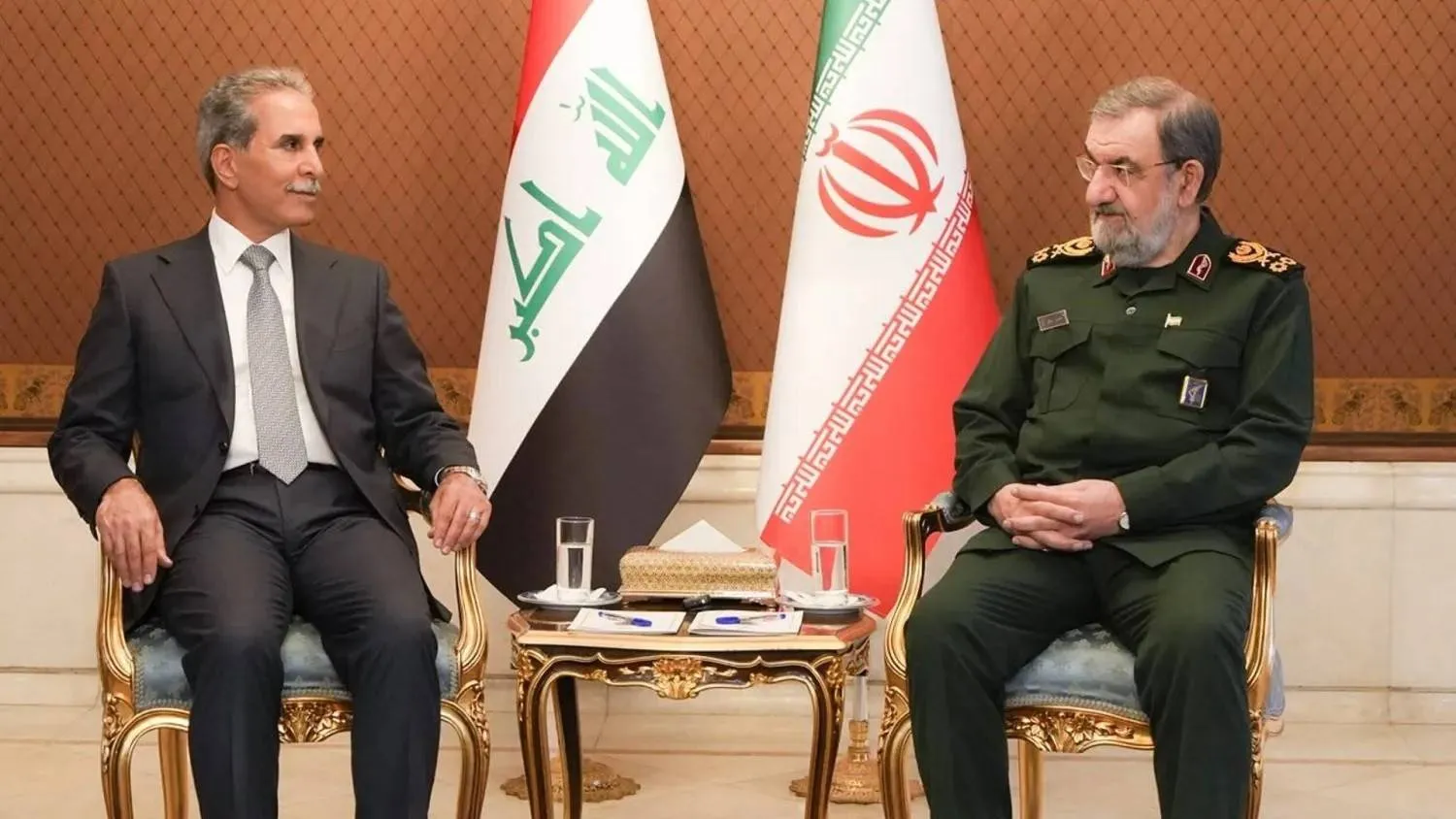
Mohsen Rezaei, secretary of Iran’s Supreme National Security Council, said on Tuesday that regional countries would shape their own future and that the United States would have no place in the region.
Rezaei made the remarks in Tehran during talks with Faiq Zidan, head of Iraq’s Supreme Judicial Council.
He said Iran wanted a strong and independent Iraq and called for a resolution to the status of Iranian opposition groups based along the two countries’ border, an apparent reference to Iranian Kurdish parties in Iraq’s Kurdistan region.
His comments came days after Iranian parliament Speaker Mohammad Baqer Ghalibaf visited Baghdad, as Iraqi Prime Minister Ali Faleh al-Zaidi’s government faces growing pressure to press ahead with its plan to bring all weapons under state control.
During Ghalibaf’s visit, Iraqi National Security Adviser Qasim al-Aboudi said the government was moving forward with the plan.
He said the constitution did not allow armed groups to threaten the security of other countries and reaffirmed Baghdad’s commitment to its security agreement with Tehran.
The circumstances surrounding the visit suggested that armed factions were a central focus of the talks, even if the issue did not formally appear on every publicly announced agenda.
Iraqi reports said Ghalibaf conveyed Tehran’s position on government measures targeting the factions’ weapons as Baghdad’s deadline for completing the process approached.
Separately, leaders of the Coordination Framework discussed the arrests of Popular Mobilization Forces (PMF) members and commanders at a meeting in Baghdad attended by Mohsen Qomi, a representative of Iran’s supreme leader.
Local media said the leaders objected to how the arrests were carried out. They argued that those wanted by the authorities could have been summoned through formal judicial procedures instead of military force.
Underscoring the sensitivity of the issue, PMF later said what it called a “misunderstanding” over the arrests of several members had been resolved. It said they had been handed over to PMF security services to pursue their cases in court.
The developments come as al-Zaidi’s government seeks to enforce a state monopoly on weapons, bringing it into direct confrontation with armed factions that wield extensive political and security influence.
The weapons issue poses a sensitive test for al-Zaidi, who is also under US pressure to dismantle armed groups operating outside state control.
Baghdad ‘appreciates Tehran’s support’
In Tehran, Rezaei and Zidan focused their talks on security and judicial ties.
Zidan said Iraq appreciated Iran’s support and stressed the need for regional cooperation and security along the shared border.
He arrived in Tehran on Tuesday at the head of a senior judicial delegation following an official invitation. The delegation included the heads of the Judicial Supervision Commission and the Public Prosecution Service, as well as the director-general of the Judicial Protection Department.
Zidan was received by the Iranian judiciary’s deputy chief for international affairs and Nasser Seraj, secretary of the judiciary’s Human Rights Council.
During the visit, Zidan also met Iranian judiciary chief Gholam-Hossein Mohseni-Ejei to discuss closer judicial and legal cooperation.
Ejei said more than 131 Iranian convicts had been transferred from Iraqi prisons over the past year. He called for better prisoner-transfer and exchange mechanisms and measures to ease the difficulties facing their families.
He also said Iranian and Iraqi security were interconnected and urged closer coordination against activities threatening their shared border.
Zidan praised relations between the two countries and said the Iraqi government and people stood with Iran against what he described as “US and Israeli aggression.” He also recalled Iran’s support for Iraq during its war against ISIS.
Zidan also discussed several issues of common interest with Ghalibaf, according to Iraq’s state news agency.