«الناتو» يعزز سرب طائراته في رومانيا لمراقبة الجيش الروسيhttps://aawsat.com/home/article/4104351/%C2%AB%D8%A7%D9%84%D9%86%D8%A7%D8%AA%D9%88%C2%BB-%D9%8A%D8%B9%D8%B2%D8%B2-%D8%B3%D8%B1%D8%A8-%D8%B7%D8%A7%D8%A6%D8%B1%D8%A7%D8%AA%D9%87-%D9%81%D9%8A-%D8%B1%D9%88%D9%85%D8%A7%D9%86%D9%8A%D8%A7-%D9%84%D9%85%D8%B1%D8%A7%D9%82%D8%A8%D8%A9-%D8%A7%D9%84%D8%AC%D9%8A%D8%B4-%D8%A7%D9%84%D8%B1%D9%88%D8%B3%D9%8A
«الناتو» يعزز سرب طائراته في رومانيا لمراقبة الجيش الروسي
بريطانيا تؤكد دعمها لأوكرانيا «حتى النصر»
طائرة «أواكس» تابعة لـ«ناتو» لدى هبوطها في قاعدة جوية قرب العاصمة الرومانية بوخارست أمس (أ.ب)
بوخارست ـ لندن: «الشرق الأوسط»
TT
TT
«الناتو» يعزز سرب طائراته في رومانيا لمراقبة الجيش الروسي
طائرة «أواكس» تابعة لـ«ناتو» لدى هبوطها في قاعدة جوية قرب العاصمة الرومانية بوخارست أمس (أ.ب)
بدأ حلف شمال الأطلسي «الناتو» تعزيز حضوره العسكري الجوي في رومانيا، بهدف مراقبة نشاط الجيش الروسي، مع ازدياد حالة التوتر على خلفية الحرب الدائرة في أوكرانيا.
ووصلت 14 طائرة مراقبة تابعة للحلف إلى رومانيا أمس الثلاثاء لتعزيز الجناح الشرقي للتكتل، على أن ينشر الحلف نحو 180 فرداً عسكرياً لدعم الطائرات. وتنتمي الطائرات التي تُنشر في رومانيا إلى سرب مكون من طائرات مراقبة تابعة للحلف، تتمركز غالباً في ألمانيا.
وأعلن الحلف الأسبوع الماضي أنَّه سينشر طائرات المراقبة المزودة بنظام الإنذار والمراقبة المحمول جواً في بوخارست، حيث ستبدأ رحلات استطلاع بشكل حصري فوق أراضي الدول الأعضاء بالحلف.
ومنذ اندلاع الحرب في أوكرانيا عزَّز الحلف حضوره الجوي في شرق أوروبا ودول البلطيق، بما يشمل الطائرات المقاتلة وطائرات المراقبة وطائرات النقل. وقالت المتحدثة باسم الحلف أوانا لونجيسكو في بيان: «في ظلّ تواصل حرب روسيا غير المشروعة في أوكرانيا لتهديد السلام والأمن في أوروبا، يجب ألا يكون ثمة شك في عزم حلف شمال الأطلسي على حماية كل شبر من أراضي الحلفاء والدفاع عنها».
وأضافت: «يمكن للمراقبة بنظام الإنذار والمراقبة المحمول جواً تحديد الطائرات على بعد مئات الكيلومترات، ما يجعلها إحدى القدرات الرئيسية في قوة ردع حلف شمال الأطلسي ووضعه الدفاعي».
في سياق متصل، جدَّد وزير الخارجية البريطاني جيمس كليفرلي أمس الثلاثاء عزم بلاده إرسال دبابات إلى أوكرانيا، لمساعدتها على «صد» الروس في شرق البلاد وجنوبها. وقال في واشنطن: «الرسالة التي نوجهها إلى بوتين هي أننا ملتزمون الدفاع عن الأوكرانيين حتى يحققوا النصر». وأضاف: «على بوتين أن يفهم أنَّنا سندعمهم استراتيجياً حتى تنجز المهمة، وأفضل شيء يمكن أن يفعله للحفاظ على أرواح قواته هو إدراك هذا الأمر». ... المزيد
أكد سكرتير مجلس الأمن القومي الروسي نيكولاي باتروشيف أن حلف شمال الأطلسي (ناتو) نشر وحدات عسكرية إضافية في أوروبا الشرقية، وقام بتدريبات وتحديثات للبنية التحتية العسكرية قرب حدود روسيا، بحسب ما نقلته وكالة الأنباء الروسية «سبوتنيك»، اليوم الأربعاء. وأكد باتروشيف في مقابلة مع صحيفة «إزفستيا» الروسية، أن الغرب يشدد باستمرار الضغط السياسي والعسكري والاقتصادي على بلاده، وأن الناتو نشر حوالى 60 ألف جندي أميركي في المنطقة، وزاد حجم التدريب العملياتي والقتالي للقوات وكثافته.
أعلنت وزارة الخارجية الإسبانية، الجمعة، أنها استدعت السفير الروسي في مدريد، بعد «هجمات» شنتها السفارة على الحكومة عبر موقع «تويتر».
وقال متحدث باسم الوزارة، لوكالة «الصحافة الفرنسية»، إن الغرض من الاستدعاء الذي تم الخميس، هو «الاحتجاج على الهجمات ضد الحكومة على مواقع التواصل الاجتماعي».
أعلن القائد العسكري الأعلى لحلف شمال الأطلسي (الناتو)، أن جميع المركبات القتالية، التي وعد حلفاء أوكرانيا الغربيون بتسليمها في الوقت المناسب، تمهيداً لهجوم الربيع المضاد المتوقع الذي قد تشنه كييف، قد وصلت تقريباً. وقال الجنرال كريستوفر كافولي، وهو أيضاً القائد الأعلى للقوات الأميركية في أوروبا، إن «أكثر من 98 في المائة من المركبات القتالية موجودة بالفعل».
وأضاف في شهادته أمام لجنة القوات المسلحة بمجلس النواب يوم الأربعاء: «أنا واثق جداً من أننا قدمنا العتاد الذي يحتاجون إليه، وسنواصل الإمدادات للحفاظ على عملياتهم أيضاً».
أعلن القائد العسكري الأعلى لحلف شمال الأطلسي (الناتو) أن جميع المركبات القتالية، التي وعد حلفاء أوكرانيا الغربيون بتسليمها في الوقت المناسب، تمهيداً لهجوم الربيع المضاد المتوقع الذي قد تشنه كييف، قد وصلت تقريباً.
وقال الجنرال كريستوفر كافولي، وهو أيضاً القائد الأعلى للقوات الأميركية في أوروبا، إن «أكثر من 98 في المائة من المركبات القتالية موجودة بالفعل». وأضاف في شهادته أمام لجنة القوات المسلحة في مجلس النواب الأميركي الأربعاء: «أنا واثق جداً من أننا قدمنا العتاد الذي يحتاجون إليه، وسنواصل الإمدادات للحفاظ على عملياتهم أيضاً».
اعترضت مقاتلات ألمانية وبريطانية ثلاث طائرات استطلاع روسية في المجال الجوي الدولي فوق بحر البلطيق، حسبما ذكرت القوات الجوية الألمانية اليوم (الأربعاء)، وفقاً لوكالة الأنباء الألمانية.
ولم تكن الطائرات الثلاث؛ طائرتان مقاتلتان من طراز «إس يو – 27» وطائرة «إليوشين إل – 20»، ترسل إشارات جهاز الإرسال والاستقبال الخاصة بها.
Major General Turki Al-Maliki, Spokesperson for the Coalition to Restore Legitimacy in Yemen (Asharq Al-Awsat)
Official Spokesperson of the Coalition to Restore Legitimacy in Yemen Major General Turki Al-Malki stated on Friday that a ballistic missile launched by the terrorist Houthi militia toward Khamis Mushait was intercepted and destroyed.
Effective Altruism: The Philosophy Behind Silicon Valley's AI Fearshttps://aawsat.com/node/5325025
Effective Altruism: The Philosophy Behind Silicon Valley's AI Fears
Effective Altruism conspicuously connects a number of leaders in American tech and finance. ANDREJ IVANOV / AFP
Dario Amodei says he is not part of it. But the Anthropic chief's personal and professional circle is entwined with Effective Altruism (EA), a philanthropic movement that has become one of the most contested ideas in Washington and Silicon Valley.
To its proponents, EA is a rational, evidence-based way to do good. To many in the Trump administration, it fuels unfounded and exaggerated fears about artificial intelligence -- the kind of warnings Amodei has become known for.
Here are some facts about EA:
- Philosophical roots -
EA is a loosely defined movement that uses evidence and reason to work out how to do the most good with a person's money and time.
Its intellectual roots can be traced to Australian philosopher Peter Singer.
If reasonable people would agree it is morally right to ruin one's clothes to save a drowning child, he argued in 1972, they should also sacrifice greater resources and comforts to save lives in foreign lands -- because the distance should not matter.
The idea took hold among wealthy donors who felt a moral obligation to give, but wanted their money to do as much good as possible.
- Giving what you can -
EA took shape as a decentralized movement during the heady, techno-optimistic days of the late 2000s and early 2010s -- when many believed social media and smartphones would promote empathy and democracy.
In 2007, financial professionals Holden Karnofsky and Elie Hassenfeld quit their jobs to launch GiveWell, which produced data-driven analyses of charities' effectiveness.
Karnofsky was once Amodei's roommate, and is now married to his sister Daniela, who co-founded Anthropic with him.
Two years later, Oxford University philosophers William MacAskill and Toby Ord launched "Giving What We Can," encouraging people to donate at least 10 percent of their income to tackling global poverty.
"The critique of the status quo was that existing attempts to evaluate the work of charities and nonprofits focused on things like overhead and executive pay," Theodore Lechterman, a philosophy professor at IE University in Madrid, told AFP.
GiveWell and others wanted to ask, "How much good is this organization actually doing in the world?" Lechterman said.
EA's three big causes today are global poverty, factory-farmed animals and "the most controversial one -- global catastrophic risk," said Richard Chappell, a professor at University of Miami and an EA proponent.
That worry about the future is where AI comes in.
- Data-driven -
Over the last 15 years, EA has found eager followers in American tech and some corners of Wall Street.
"Since the movement is data driven, it's a relatively easier sell to people who...make decisions on the basis of data," Lechterman said.
That numbers-backed thinking means engineers, software developers or entrepreneurs might all find it more appealing than humanities graduates, Lechterman said.
Among them was Sam Bankman-Fried, the crypto-finance wunderkind sentenced in 2024 to 25 years in prison for fraud.
A vocal champion of the movement, Bankman-Fried said he went into finance to make a fortune he could give away.
He also was an early investor in Anthropic.
- EA and AI -
As AI worries grew, EA philosophers such as MacAskill were "kind of thinking about the future of humanity," said Brian Berkey of the University of Pennsylvania.
The result was long-termism, a philosophy that "came to play a very central role" in the movement.
MacAskill reportedly brokered contacts between Bankman-Fried and Elon Musk.
Musk was for years outspoken about the threat he believed AI posed to humanity, and in 2015 helped create OpenAI to guard against it.
EA's focus on AI also owes much to a neighboring movement, rationalism -- an online community that grew up around writer Eliezer Yudkowsky, who has warned since the 2000s that superintelligent AI could wipe out humanity.
The two movements overlap heavily in membership and ideas, sharing an emphasis on reasoning through evidence and probabilities, and a conviction that preventing human extinction should be a top priority.
Both converged last month on Jacob Coxon, a 27-year-old researcher who quit Anthropic warning that AI companies were "gambling with our lives." His post was viewed more than 100 million times.
Days later, Amodei published a lengthy essay arguing that AI's mounting risks warranted a slowdown.
When the World Saw van Gogh as ‘a Madman,’ she Saw his Geniushttps://aawsat.com/node/5325024
“Four Sunflowers Gone to Seed” Credit...Ilvy Njiokiktjien for The New York Times
TT
TT
When the World Saw van Gogh as ‘a Madman,’ she Saw his Genius
“Four Sunflowers Gone to Seed” Credit...Ilvy Njiokiktjien for The New York Times
By Nina Siegal
It was April 1912, and Helene Kröller-Müller was on a shopping spree. She wasn’t interested in the latest shoes or fashions. She was on the hunt for Vincent van Gogh’s portrait of Madame Augustine Roulin.
She managed to find “La Berceuse,” as the painting is known, at a Paris gallery, and bought it on the spot. The next day, she went from gallery to gallery, looking for more van Gogh paintings, and took home a great haul: 15 in a single trip.
Kröller-Müller, a German heiress, had made it her life’s goal to establish a great public collection of modern art. She became one of the first major collectors to recognize van Gogh’s genius.
Now, more than a century after that Paris shopping spree, the entire collection of van Gogh paintings she assembled is on view together at the museum she built in the middle of a Dutch forest — for the first time since 1984.
It is the second-largest trove of van Gogh’s works anywhere, after the Van Gogh Museum in Amsterdam, and it was assembled by a woman who took great risks in buying his art at a time when few others dared.
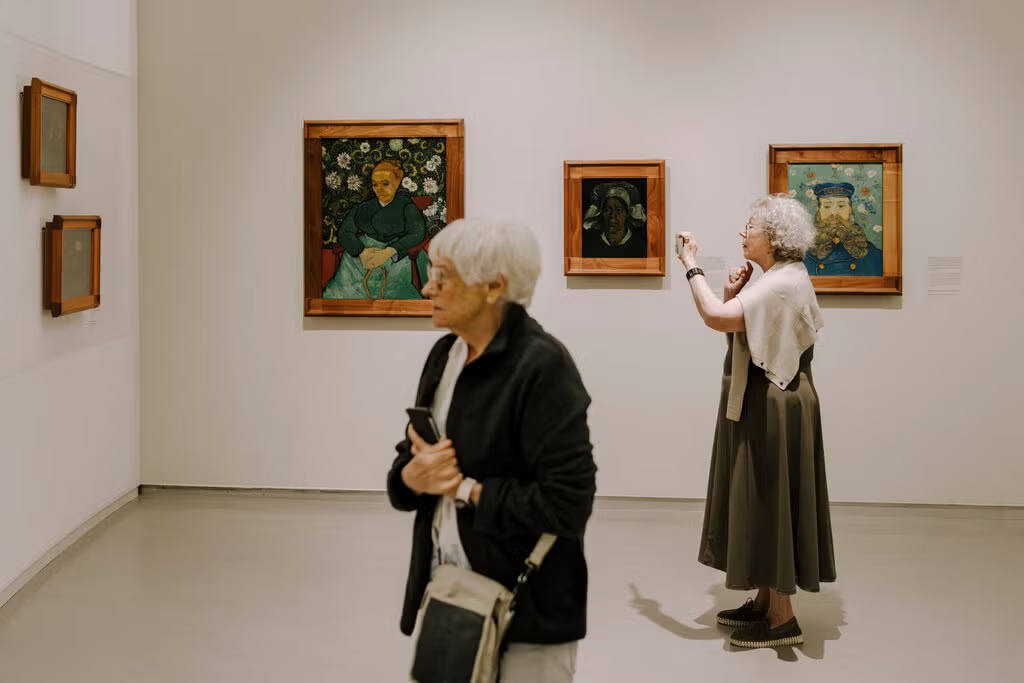
The exhibition “Van Gogh: All Our Paintings” includes works like “La Berceuse,” hanging on the left side of the rear wall. Credit...Ilvy Njiokiktjien for The New York Times
The exhibition at the Kröller-Müller Museum in Otterlo, the Netherlands, called “Van Gogh: All Our Paintings” and running through Jan. 3, presents the whole collection as Kröller-Müller conceived it: an expression of the artist’s development, range and spiritual aspirations.
“This is a rare moment that all the paintings are in the house,” said Benno Tempel, the museum’s director. “It hasn’t happened for such a long time.”
The show is organized around three themes — faith, hope and love — reflecting the spiritual dimension that Kröller-Müller saw in van Gogh’s work. It includes many of his popular works, scattered throughout these broad categories, such as “Café Terrace at Night,” “Portrait of Joseph Roulin” and “The Sower.”
Kröller-Müller, the daughter of a German industrialist, had an early interest in art but had to end her formal education at age 16. At 18, she married one of her father’s employees, who would later take over the family business. Her husband, Anton Müller, encouraged her intellectual pursuits, including her interest in art, a socially acceptable hobby for wealthy women of the era.
“If you were married at the time, you gave all your money and assets to your husband," said the exhibition’s curator, Renske Cohen Tervaert. “So it was quite open-minded of him, in a way, to allow her to follow her dream in this way.”
But Kröller-Müller didn’t collect as a hobbyist. She embraced art with a kind of religious fervor.
She bought her first van Gogh painting in 1908 for 110 guilders — about the price of an exquisite dress, said Eva Rovers, her biographer. Four months later, she bought his “Four Sunflowers Gone to Seed” for 4,000 guilders.
Prices were rising in large part because she was buying so much.
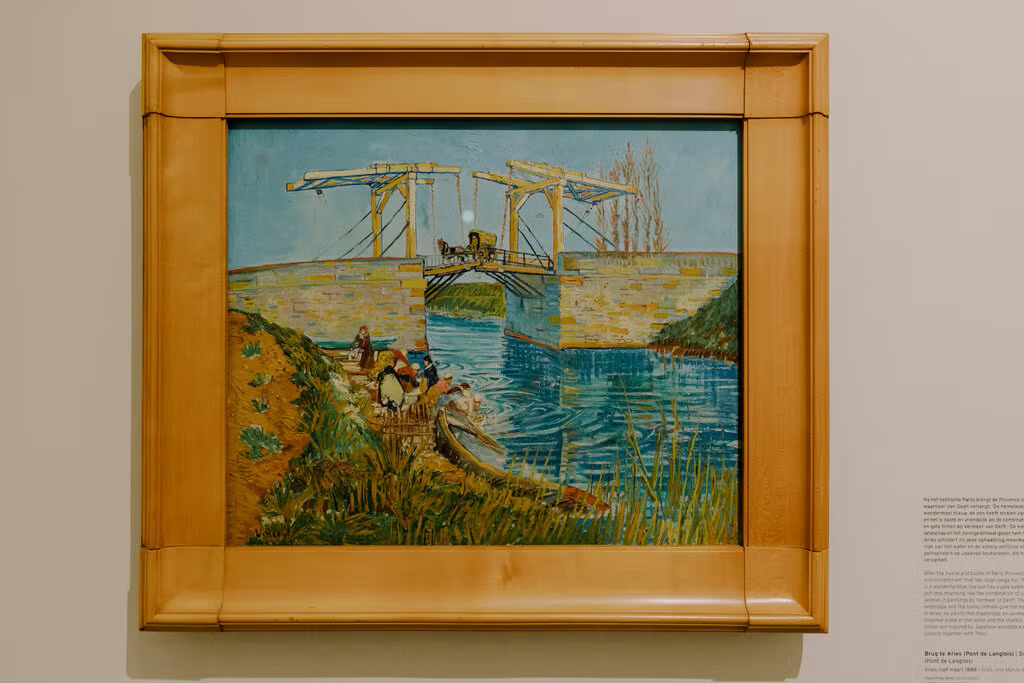
“Bridge at Arles” Credit...Ilvy Njiokiktjien for The New York Times
Kröller-Müller’s collecting philosophy was largely shaped by the art historian Henk Bremmer, with whom she took an art appreciation class, Tervaert said. She added that for Bremmer, the key component of good art was that it made the viewer feel an emotion or experience something spiritual.
Kröller-Müller went looking for art that stirred her spirit and found van Gogh.
Rovers said that van Gogh was not well regarded in the early 20th century. “If the general public knew him at all, they really considered him a madman who could not paint,” she said.
But because van Gogh had been a preacher before becoming an artist, Kröller-Müller regarded him as a man who had found a connection to faith through his art.
“She understood his wish to transcend suffering, and his aim to use art to transcend suffering,” Rovers said.
While most collectors in the Netherlands were buying old masters and 19th-century Dutch painting, Kröller-Müller focused on Cubism, Pointillism and De Stijl artists, including Piet Mondrian, Fernand Léger and Pablo Picasso.
Van Gogh’s work dominated the collection for a simple reason, Rovers said: He “stood at the cradle of the beginning of avant-garde art.” Kröller-Müller built a collection, Rovers added, “that could show the broad variety of his work — landscapes, portraits, cityscapes.”
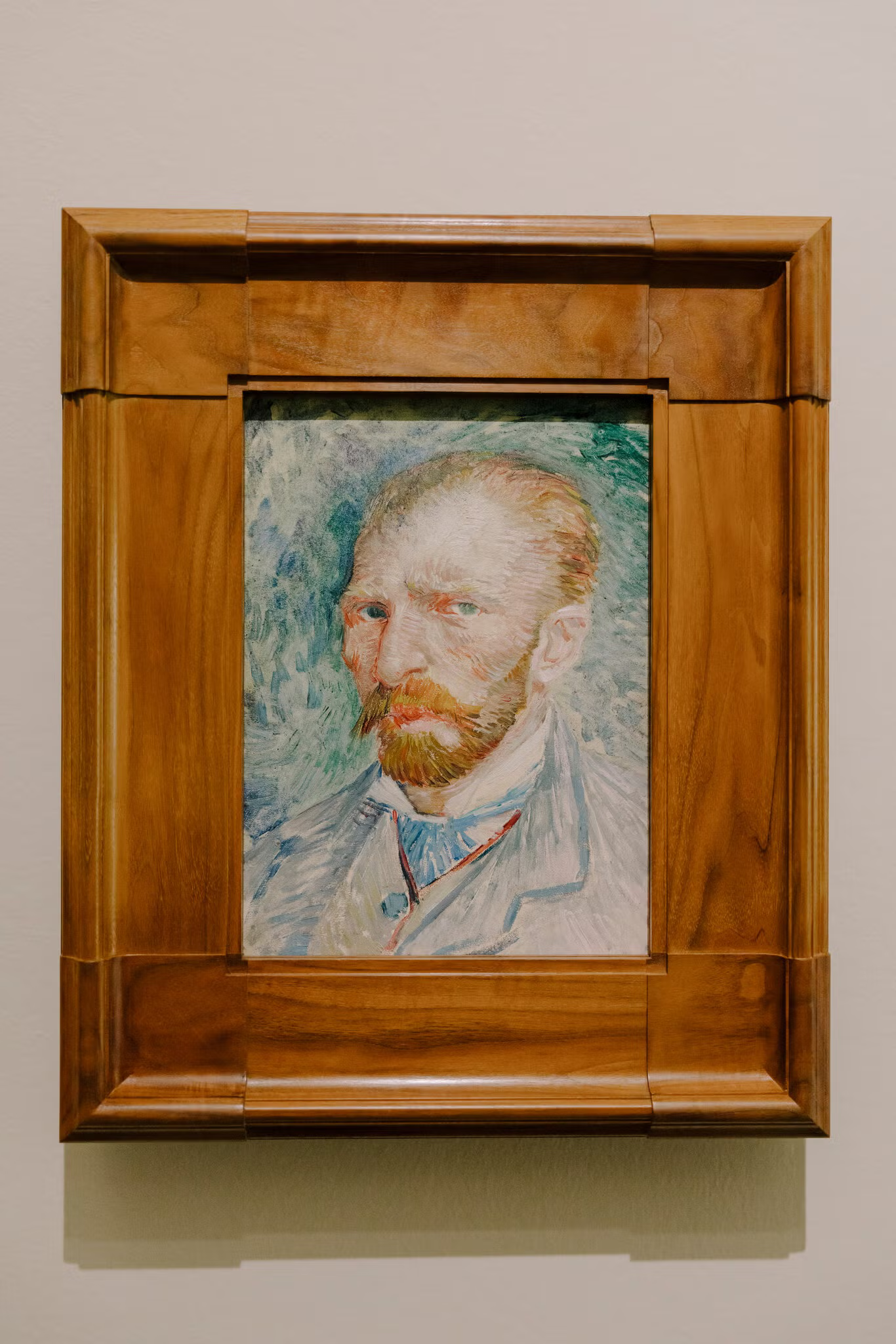
A van Gogh self-portrait from 1887. The show is organized around the themes of faith, hope and love. Credit...Ilvy Njiokiktjien for The New York Times
In the late 1930s, as Europe was approaching World War II, Kröller-Müller’s health was declining, along with her family fortune.
She decided to offer her art collection, worth about 4 million guilders at the time, along with family property in the Veluwe forest, to the Dutch state, as long as it would agree to build a museum to display it. She imagined the museum, with a 62-acre sculpture garden, as a retreat for spiritual and philosophical inquiry.
The result was a rare trove in a remote Dutch forest — now a national park — built around her collection.
The Van Gogh Museum in Amsterdam has more than 200 paintings, but its collection has a different history: It was established to show the collection of the van Gogh family, who owned the artist’s unsold works. The Kröller-Müller represents a collector’s eye.
“The Van Gogh Museum is just what was left over,” Tempel said. “This is a chosen collection.”
The New York Times
لم تشترك بعد
انشئ حساباً خاصاً بك لتحصل على أخبار مخصصة لك ولتتمتع بخاصية حفظ المقالات وتتلقى نشراتنا البريدية المتنوعة