تبين أنك لست الوحيد الذي يحتاج إلى قسط جيد من الراحة ليلاً للعمل بشكل جيد في اليوم التالي، حيث وجد باحثون من جامعة سينسيناتي الأميركية، أن البعوض يشاركك هذا السلوك.
ووجد الباحثون أن البعوض الذي تم حرمانه من النوم، كان مهموماً أكثر في اليوم التالي بتعويض ما فاته، أكثر من اهتمامه بالحصول على وجبته من الدم، حسب دراسة في دورية «البيولوجيا التجريبية».
ولوحظت ظاهرة تعويض النوم في نحل العسل وذباب الفاكهة والبشر، ولكنها المرة الأولى التي تسجل في البعوض، وذلك بعد أن أمضى الباحثون أكثر من عام في تطوير بروتوكولات لدراسة نوم البعوض.
وكان من الصعب تحديد كمية النوم في البعوض، لأنك بمجرد أن تمشي في الغرفة مثلاً تعتبر بمثابة عشاء لبعضه، حيث يشعر بالناس من خلال حرارة أجسامهم، والروائح، والحركة، والاهتزازات، وثاني أكسيد الكربون الذي ينفثونه من رئتيهم وينبعث من جلدهم، لذلك قام الباحثون بإعداد تجربة معملية محكمة، حيث تم فصل البعوض في غرف، وتم وضع كاميرات وأجهزة استشعار تعمل بالأشعة تحت الحمراء يمكنها تسجيل وقت تحرك البعوض دون إزعاج.
ودرس الباحثون سلوكيات النوم والتغذية لدى البعوض لمدة أسبوع تقريباً بعد تأقلمه مع موطنه التجريبي الجديد، وفي تجربة ثانية، عرّضه الباحثون للحرمان من النوم أثناء وقت نومه المعتاد عن طريق اهتزاز عبواته على فترات منتظمة خلال النهار أو الليل.
وفي حين أن أكثر من 75 في المائة من البعوض الذي لم يتعرض للحرمان من النوم سعى إلى تناول وجبة دم، فإن النسبة الباقية لم يكن لديها أي اهتمام بالطعام بعد ليلة بلا نوم، وهو ما أثار دهشة الباحثين، لأنه بقدر ما يحتاج البعوض إلى الدم لإنتاج البيض، فإنه تخلى عنه لاستعادة النوم الذي فقده.
ويقول أولواسون أجايي، من قسم العلوم البيولوجية بجامعة سينسيناتي، لـ«الشرق الأوسط»، إن الخطوة التالية ستكون تحديد أهداف الجينات المشاركة في نوم البعوض، حيث يمكن أن يساعد ذلك في تطوير مواد كيميائية ومنتجات جديدة يمكن نشرها للتحكم في هذه الآفة المزعجة وإدارتها.
وعن انعكاس دراسة النوم عند البعوض على البشر، يضيف: «في حين أن البشر والبعوض مختلفون من حيث علم وظائف الأعضاء، فإن النوم مهم لكل منهما في استقلاب الطاقة واستعادة النشاط».
Effective Altruism: The Philosophy Behind Silicon Valley's AI Fears
Effective Altruism conspicuously connects a number of leaders in American tech and finance. ANDREJ IVANOV / AFP
Dario Amodei says he is not part of it. But the Anthropic chief's personal and professional circle is entwined with Effective Altruism (EA), a philanthropic movement that has become one of the most contested ideas in Washington and Silicon Valley.
To its proponents, EA is a rational, evidence-based way to do good. To many in the Trump administration, it fuels unfounded and exaggerated fears about artificial intelligence -- the kind of warnings Amodei has become known for.
Here are some facts about EA:
- Philosophical roots -
EA is a loosely defined movement that uses evidence and reason to work out how to do the most good with a person's money and time.
Its intellectual roots can be traced to Australian philosopher Peter Singer.
If reasonable people would agree it is morally right to ruin one's clothes to save a drowning child, he argued in 1972, they should also sacrifice greater resources and comforts to save lives in foreign lands -- because the distance should not matter.
The idea took hold among wealthy donors who felt a moral obligation to give, but wanted their money to do as much good as possible.
- Giving what you can -
EA took shape as a decentralized movement during the heady, techno-optimistic days of the late 2000s and early 2010s -- when many believed social media and smartphones would promote empathy and democracy.
In 2007, financial professionals Holden Karnofsky and Elie Hassenfeld quit their jobs to launch GiveWell, which produced data-driven analyses of charities' effectiveness.
Karnofsky was once Amodei's roommate, and is now married to his sister Daniela, who co-founded Anthropic with him.
Two years later, Oxford University philosophers William MacAskill and Toby Ord launched "Giving What We Can," encouraging people to donate at least 10 percent of their income to tackling global poverty.
"The critique of the status quo was that existing attempts to evaluate the work of charities and nonprofits focused on things like overhead and executive pay," Theodore Lechterman, a philosophy professor at IE University in Madrid, told AFP.
GiveWell and others wanted to ask, "How much good is this organization actually doing in the world?" Lechterman said.
EA's three big causes today are global poverty, factory-farmed animals and "the most controversial one -- global catastrophic risk," said Richard Chappell, a professor at University of Miami and an EA proponent.
That worry about the future is where AI comes in.
- Data-driven -
Over the last 15 years, EA has found eager followers in American tech and some corners of Wall Street.
"Since the movement is data driven, it's a relatively easier sell to people who...make decisions on the basis of data," Lechterman said.
That numbers-backed thinking means engineers, software developers or entrepreneurs might all find it more appealing than humanities graduates, Lechterman said.
Among them was Sam Bankman-Fried, the crypto-finance wunderkind sentenced in 2024 to 25 years in prison for fraud.
A vocal champion of the movement, Bankman-Fried said he went into finance to make a fortune he could give away.
He also was an early investor in Anthropic.
- EA and AI -
As AI worries grew, EA philosophers such as MacAskill were "kind of thinking about the future of humanity," said Brian Berkey of the University of Pennsylvania.
The result was long-termism, a philosophy that "came to play a very central role" in the movement.
MacAskill reportedly brokered contacts between Bankman-Fried and Elon Musk.
Musk was for years outspoken about the threat he believed AI posed to humanity, and in 2015 helped create OpenAI to guard against it.
EA's focus on AI also owes much to a neighboring movement, rationalism -- an online community that grew up around writer Eliezer Yudkowsky, who has warned since the 2000s that superintelligent AI could wipe out humanity.
The two movements overlap heavily in membership and ideas, sharing an emphasis on reasoning through evidence and probabilities, and a conviction that preventing human extinction should be a top priority.
Both converged last month on Jacob Coxon, a 27-year-old researcher who quit Anthropic warning that AI companies were "gambling with our lives." His post was viewed more than 100 million times.
Days later, Amodei published a lengthy essay arguing that AI's mounting risks warranted a slowdown.
When the World Saw van Gogh as ‘a Madman,’ she Saw his Geniushttps://aawsat.com/node/5325024
“Four Sunflowers Gone to Seed” Credit...Ilvy Njiokiktjien for The New York Times
TT
TT
When the World Saw van Gogh as ‘a Madman,’ she Saw his Genius
“Four Sunflowers Gone to Seed” Credit...Ilvy Njiokiktjien for The New York Times
By Nina Siegal
It was April 1912, and Helene Kröller-Müller was on a shopping spree. She wasn’t interested in the latest shoes or fashions. She was on the hunt for Vincent van Gogh’s portrait of Madame Augustine Roulin.
She managed to find “La Berceuse,” as the painting is known, at a Paris gallery, and bought it on the spot. The next day, she went from gallery to gallery, looking for more van Gogh paintings, and took home a great haul: 15 in a single trip.
Kröller-Müller, a German heiress, had made it her life’s goal to establish a great public collection of modern art. She became one of the first major collectors to recognize van Gogh’s genius.
Now, more than a century after that Paris shopping spree, the entire collection of van Gogh paintings she assembled is on view together at the museum she built in the middle of a Dutch forest — for the first time since 1984.
It is the second-largest trove of van Gogh’s works anywhere, after the Van Gogh Museum in Amsterdam, and it was assembled by a woman who took great risks in buying his art at a time when few others dared.
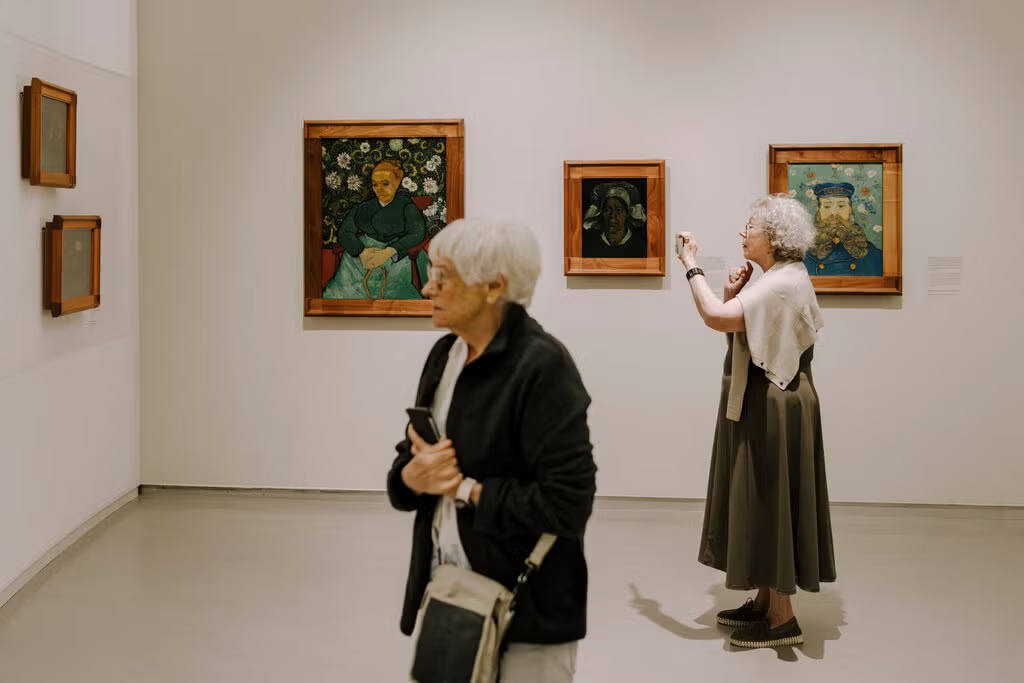
The exhibition “Van Gogh: All Our Paintings” includes works like “La Berceuse,” hanging on the left side of the rear wall. Credit...Ilvy Njiokiktjien for The New York Times
The exhibition at the Kröller-Müller Museum in Otterlo, the Netherlands, called “Van Gogh: All Our Paintings” and running through Jan. 3, presents the whole collection as Kröller-Müller conceived it: an expression of the artist’s development, range and spiritual aspirations.
“This is a rare moment that all the paintings are in the house,” said Benno Tempel, the museum’s director. “It hasn’t happened for such a long time.”
The show is organized around three themes — faith, hope and love — reflecting the spiritual dimension that Kröller-Müller saw in van Gogh’s work. It includes many of his popular works, scattered throughout these broad categories, such as “Café Terrace at Night,” “Portrait of Joseph Roulin” and “The Sower.”
Kröller-Müller, the daughter of a German industrialist, had an early interest in art but had to end her formal education at age 16. At 18, she married one of her father’s employees, who would later take over the family business. Her husband, Anton Müller, encouraged her intellectual pursuits, including her interest in art, a socially acceptable hobby for wealthy women of the era.
“If you were married at the time, you gave all your money and assets to your husband," said the exhibition’s curator, Renske Cohen Tervaert. “So it was quite open-minded of him, in a way, to allow her to follow her dream in this way.”
But Kröller-Müller didn’t collect as a hobbyist. She embraced art with a kind of religious fervor.
She bought her first van Gogh painting in 1908 for 110 guilders — about the price of an exquisite dress, said Eva Rovers, her biographer. Four months later, she bought his “Four Sunflowers Gone to Seed” for 4,000 guilders.
Prices were rising in large part because she was buying so much.
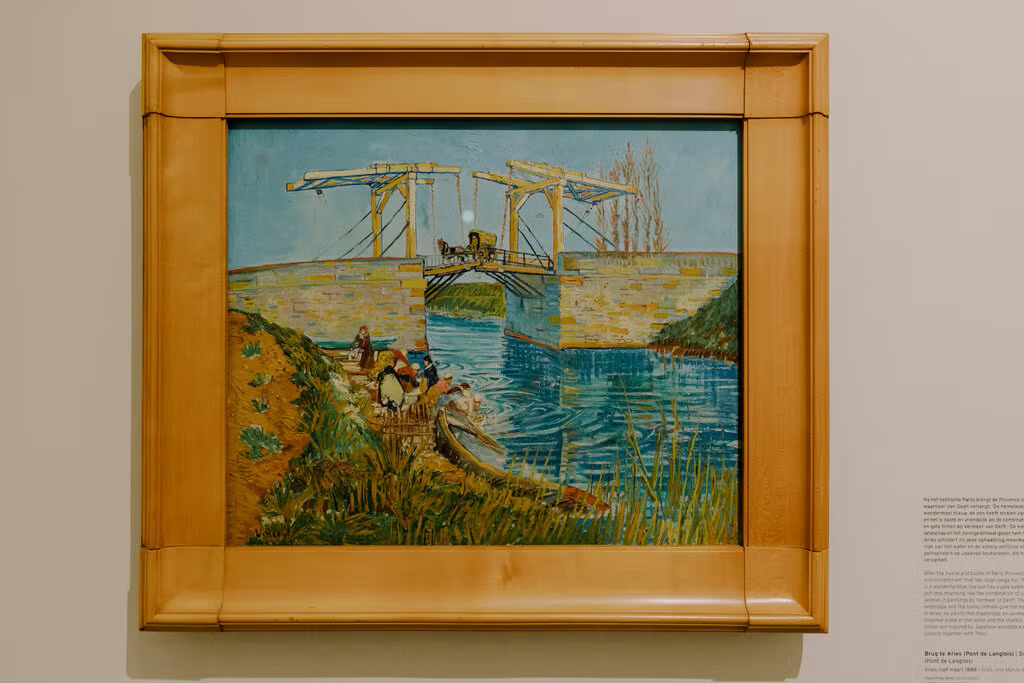
“Bridge at Arles” Credit...Ilvy Njiokiktjien for The New York Times
Kröller-Müller’s collecting philosophy was largely shaped by the art historian Henk Bremmer, with whom she took an art appreciation class, Tervaert said. She added that for Bremmer, the key component of good art was that it made the viewer feel an emotion or experience something spiritual.
Kröller-Müller went looking for art that stirred her spirit and found van Gogh.
Rovers said that van Gogh was not well regarded in the early 20th century. “If the general public knew him at all, they really considered him a madman who could not paint,” she said.
But because van Gogh had been a preacher before becoming an artist, Kröller-Müller regarded him as a man who had found a connection to faith through his art.
“She understood his wish to transcend suffering, and his aim to use art to transcend suffering,” Rovers said.
While most collectors in the Netherlands were buying old masters and 19th-century Dutch painting, Kröller-Müller focused on Cubism, Pointillism and De Stijl artists, including Piet Mondrian, Fernand Léger and Pablo Picasso.
Van Gogh’s work dominated the collection for a simple reason, Rovers said: He “stood at the cradle of the beginning of avant-garde art.” Kröller-Müller built a collection, Rovers added, “that could show the broad variety of his work — landscapes, portraits, cityscapes.”
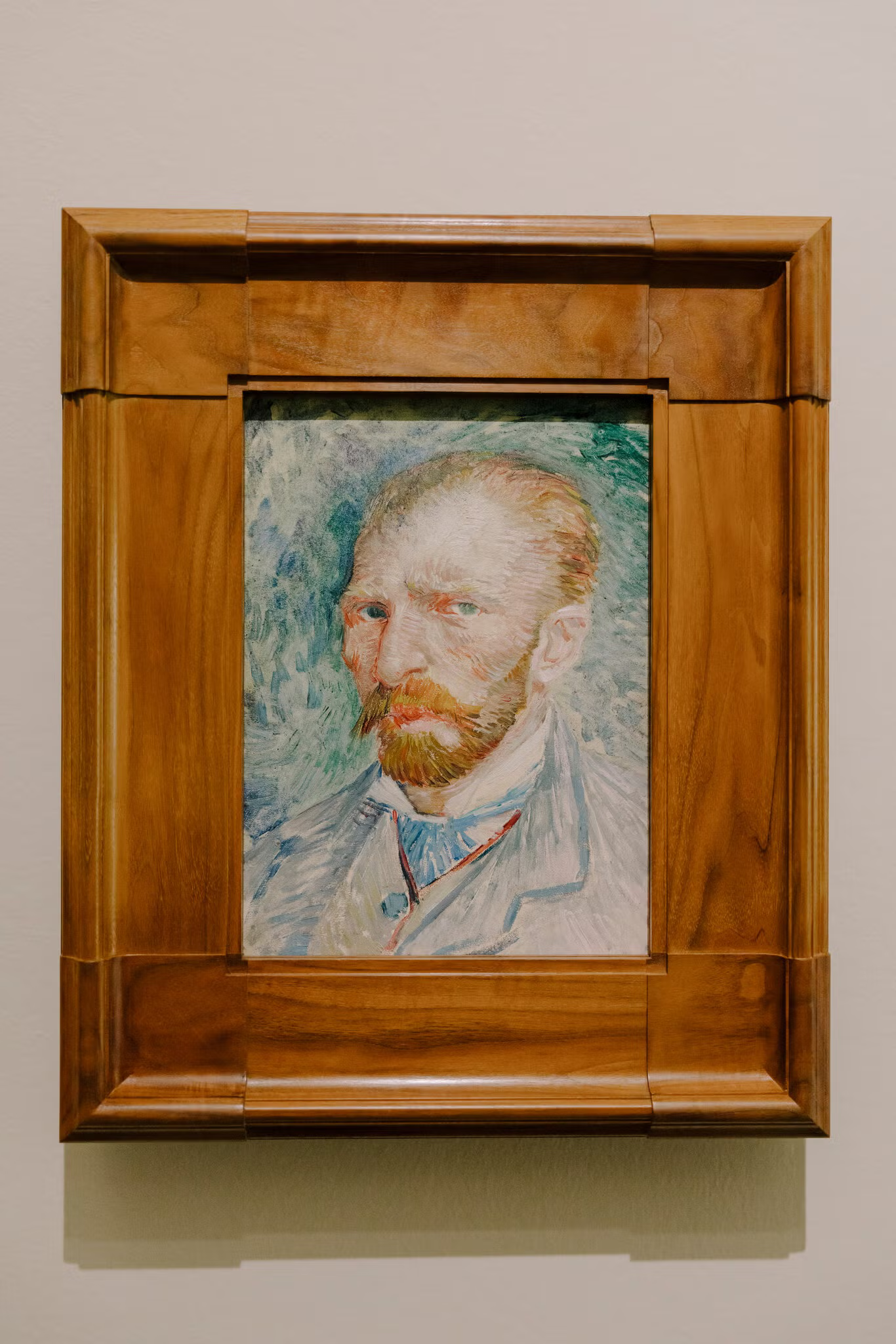
A van Gogh self-portrait from 1887. The show is organized around the themes of faith, hope and love. Credit...Ilvy Njiokiktjien for The New York Times
In the late 1930s, as Europe was approaching World War II, Kröller-Müller’s health was declining, along with her family fortune.
She decided to offer her art collection, worth about 4 million guilders at the time, along with family property in the Veluwe forest, to the Dutch state, as long as it would agree to build a museum to display it. She imagined the museum, with a 62-acre sculpture garden, as a retreat for spiritual and philosophical inquiry.
The result was a rare trove in a remote Dutch forest — now a national park — built around her collection.
The Van Gogh Museum in Amsterdam has more than 200 paintings, but its collection has a different history: It was established to show the collection of the van Gogh family, who owned the artist’s unsold works. The Kröller-Müller represents a collector’s eye.
“The Van Gogh Museum is just what was left over,” Tempel said. “This is a chosen collection.”
The New York Times
Bolivya’da başsavcı ve 13 kişi, uyuşturucu kaçakçılarını koruma suçlamasıyla gözaltına alındıhttps://aawsat.com/node/5325026
Bolivya’da başsavcı ve 13 kişi, uyuşturucu kaçakçılarını koruma suçlamasıyla gözaltına alındı
Bolivya polisi. (EPA)
Bolivya hükümeti dün, polisin ülkenin başsavcısını ve 13 kişiyi uyuşturucu kaçakçılarını korumakla suçlayarak gözaltına aldığını açıkladı. Gözaltılar, ABD Başkanı Donald Trump yönetiminin yolsuzluk iddiaları nedeniyle başsavcı ve bazı üst düzey Bolivyalı yetkililere yönelik vize kısıtlamaları getirmesinden birkaç gün sonra gerçekleşti.
2024 yılında, ülkenin önceki sosyalist hükümeti döneminde altı yıllık bir görev süresi için atanan Bolivya Başsavcısı Roger Mariaca’nın gözaltına alınması, muhafazakâr Devlet Başkanı Rodrigo Paz’ın Washington’la güvenlik iş birliğini güçlendirdiği bir zamanda gerçekleşti.
ABD Dışişleri Bakanı Marco Rubio, gözaltıları memnuniyetle karşıladı ve bunları “Bolivya’da uyuşturucu kaçakçılığı, sistematik yolsuzluk ve sınır aşan organize suçla mücadelede cesur ve kararlı adımlar” olarak nitelendirdi.
Mariaca, gözaltına alınmasıyla ilgili henüz açıklama yapmadı. Ancak daha önce kendisine yöneltilen, uyuşturucu kaçakçılığını kolaylaştırmak karşılığında rüşvet aldığı yönündeki ABD suçlamalarını reddetmiş ve bunları makamına yönelik siyasi baskı olarak nitelendirmişti.
Uyuşturucuyla mücadeleden sorumlu savcı Miguel Gonzalez, çarşamba gecesi yaptığı açıklamada, polisin Mariaca’yı savcılık kararı olmadan gözaltına aldığını söyledi.
Bolivya İçişleri Bakanı Marco Antonio Oviedo ise dün gazetecilere yaptığı açıklamada, “Adalet sisteminin içine kadar nüfuz etmiş bir suç örgütünü çökerttik” dedi. Şarku’l Avsat’ın edindiği bilgiye göre Oviedo, Mariaca’nın kara para aklama ve uyuşturucu kaçakçılığı suçlamalarıyla karşı karşıya kalacağını belirtti.
لم تشترك بعد
انشئ حساباً خاصاً بك لتحصل على أخبار مخصصة لك ولتتمتع بخاصية حفظ المقالات وتتلقى نشراتنا البريدية المتنوعة